Whole-home water filtration and reverse osmosis are often grouped together, but they don’t address the same problem. One treats most of the water entering your house, while the other focuses on the water you actually drink and cook with.
If you’ve been searching for the right water treatment setup for your Toms River home, this guide breaks down what each system actually does, where they overlap, and how to figure out which one — or both — makes sense for your family.
Why More Toms River Homeowners Are Thinking About Their Water Quality
The Toms River area relies on groundwater from aquifer systems such as the Kirkwood-Cohansey, and local water chemistry can vary by source and location. USGS research has found that groundwater in the unconfined Kirkwood-Cohansey system can be corrosive, which makes local water testing important when choosing a treatment system.
New Jersey has also taken an active role in regulating PFAS in drinking water and has established state drinking water standards. Sometimes called “forever chemicals” in water, per- and polyfluoroalkyl substances (PFAS) have been detected in drinking-water systems and private wells across the state, which is one reason homeowners may want to test their water quality.
What Is a Whole-Home Water Filtration System?
A whole-home water filtration system is installed at the point where your main water line enters the house. Water entering the home passes through the treatment system before reaching faucets, showers, appliances, and other fixtures connected to the home’s plumbing.
These systems typically use a combination of sediment filters, carbon filtration, and sometimes specialty media designed to target chlorine, chemicals, or other contaminants specific to your area. If hard water is contributing to scale buildup, a water softener or scale-control system may be more appropriate than a conventional filter, since filtration alone does not necessarily remove hardness minerals.
What Is a Reverse Osmosis System?
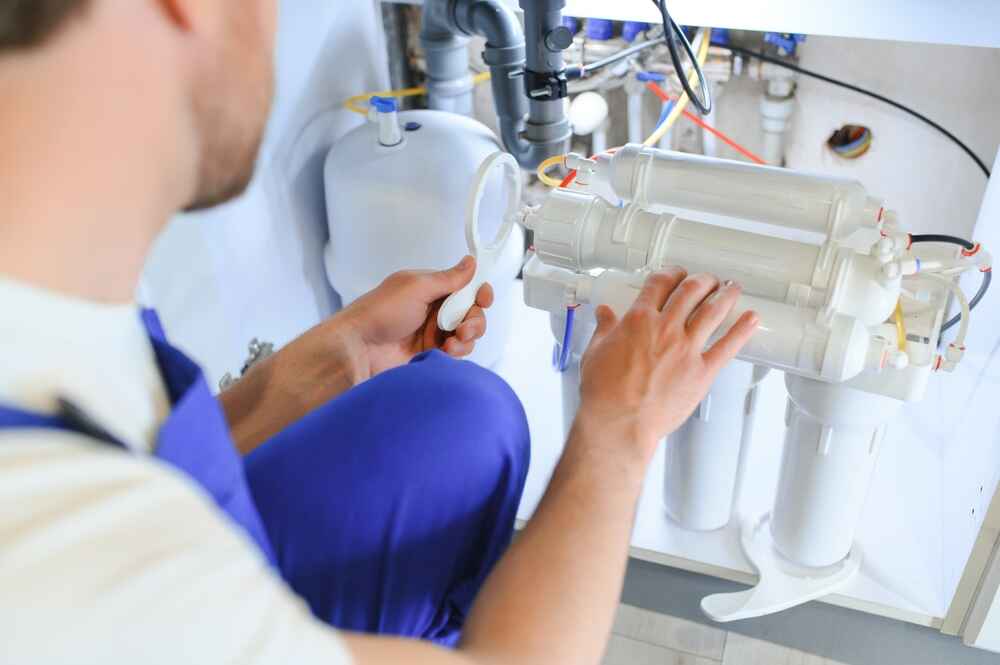
A reverse osmosis water filter is usually installed at the point of use, such as beneath the kitchen sink, so it can focus treatment on water used for drinking and cooking. Reverse osmosis (RO) can provide highly treated drinking water by forcing water through a semipermeable membrane. Depending on the system, RO can reduce contaminants such as lead, copper, chromium, chloride, sodium, and other dissolved substances.
Because drinking water systems are designed around different treatment goals, the right choice depends on the contaminants you want to reduce and where you want the treated water. An RO system won’t do anything for the water running through your shower or dishwasher, since it’s built to treat a much smaller volume at a single point of use.
Whole-Home Water Filtration vs. Reverse Osmosis: What’s the Difference?
When comparing water filtration vs. reverse osmosis, the biggest differences are:
- Where the system is installed.
- How much water it treats.
- Which contaminants it’s designed to reduce.
Whole-home filtration treats water entering the home, making it useful when a specific contaminant or water-quality issue needs to be addressed throughout the house. If hard water or scale is the issue, a softener or scale-control system may be needed instead.
If PFAS “forever chemicals” are a concern you’re weighing, look for a system certified for the specific PFAS reduction claim you need, rather than assuming any filter will remove them. No single treatment technology removes every contaminant, which is why identifying the issue first matters so much.
Which Water Treatment System Is Right for Your Home?
There’s no single answer to which is better, because they’re built to solve different problems. The right choice comes down to what you’re trying to fix and how your household uses water.
Whole-home filtration
The best starting point is usually identifying the water quality issue first. Once you know whether you’re dealing with chlorine, sediment, hardness, PFAS forever chemicals, lead, or another concern, you can choose a system designed to address that specific problem throughout the house.
Reverse osmosis
If PFAS is your primary concern, a properly certified reverse osmosis system can be an effective point-of-use option for reducing certain PFAS in drinking and cooking water. It’s also a strong option for households focused on reducing specific contaminants or wanting highly treated water for drinking, cooking, and making coffee.
Many homes benefit from both
For some Toms River homes, combining whole-home treatment with a reverse osmosis system can address multiple water-quality goals at the same time. You can cover the whole house while providing additional treatment for drinking and cooking water.
Should You Test Your Water Before Choosing a Water Filtration System?
Home water testing before buying a filtration system is one of the smarter moves a homeowner can make. Without knowing what’s actually in your water, you’re essentially guessing at which system will solve your problem.
If you use public water, start with your utility’s annual water-quality report. If your home has a private well, consider routine testing through a state-certified laboratory and use those results to determine which treatment technologies are appropriate.
What Other Water Treatment Options Should Homeowners Consider?
Water filtration and reverse osmosis aren’t the only tools available for improving water quality at home.
Water softeners
A water softener is not the same as a filtration system, even though people often use the terms interchangeably. Softeners address hard water by removing calcium and magnesium through an ion-exchange process, helping reduce scale buildup in pipes, water heaters, and appliances.
Water conditioning systems
Some water conditioning systems use template-assisted crystallization (TAC), a scale-control technology that does not work like an ion-exchange softener. TAC is intended to reduce scale formation rather than remove calcium and magnesium from the water. It’s not equivalent to traditional water softening.
Signs Your Home May Benefit From Water Filtration
A few common signs may show up before homeowners decide to make a change:
- Water that smells like chlorine or has a faint chemical odor
- Cloudy or discolored water coming from the tap
- Dry-feeling skin or hair after showers, which can sometimes be associated with hard water
- A local water quality report that lists elevated PFAS, lead, or other contaminants
- Visible scale buildup or water-using appliances affected by hard-water deposits, including water heaters
If any of these sound familiar, it’s usually a sign that your current water setup needs help. Testing can help determine which type of water treatment makes sense.
Choosing the Right Water Treatment Solution Starts With the Right Information
There’s no one-size-fits-all system. Your home’s water source, the age of your plumbing, and your family’s specific concerns all play a role in determining the appropriate water treatment solution.
Maintenance schedules vary by system, water quality, and household usage. Follow the manufacturer’s recommended schedule for replacing filter cartridges, membranes, and other treatment components.
Improve Your Home’s Water Quality With Help From MyGuy Plumbing & Drain
MyGuy Plumbing & Drain is a family-owned, locally owned plumbing company serving Toms River, Ocean County, and southern Monmouth County, with water filtration, water conditioning, and water softener solutions available for local homeowners. Whether you’re leaning toward whole-home water filtration, reverse osmosis, or a combination of both, our team can walk you through options given your water, plumbing, and budget.
Contact us today to schedule a water analysis and discuss your home’s water treatment options.